
 Отправить сообщение


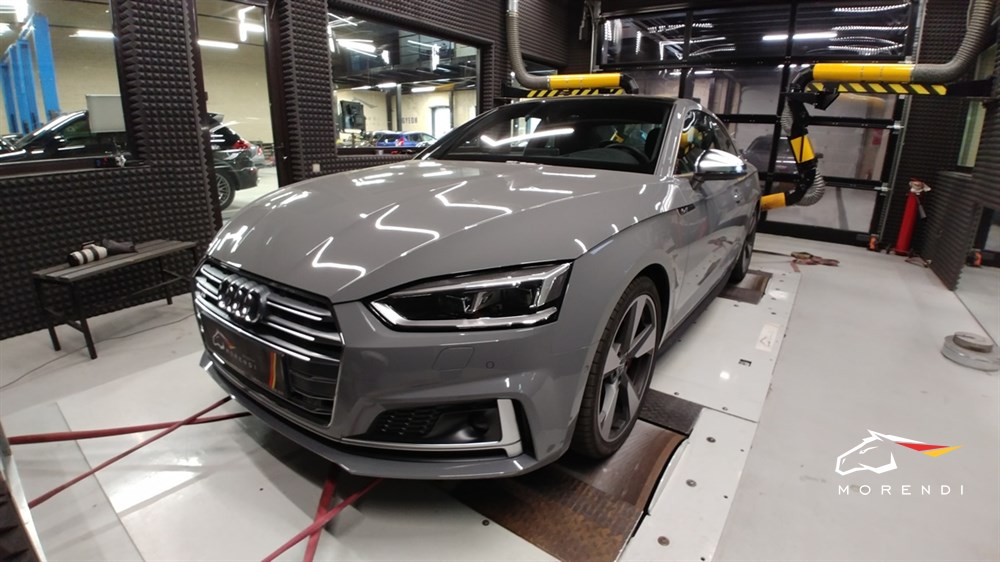
Чип тюнинг Audi S5 3.0 TFSI (354 л.с.)


Размещая заказ, Вы соглашаетесь с условиями оказания услуги.
Audi S5 3.0 TFSI (EA839) — Bosch MG1CS002
Technical Overview, Tuning Potential & Reliability
Powertrain at a Glance
-
Engine: V6 3.0 TFSI, EA839 (single twin-scroll turbo, air-to-water charge cooling)
-
ECU: Bosch MG1CS002 (torque-model based, SFD/Sec-Access protected)
-
Rated output (stock): ~354 hp (260 kW) @ ~5400–6400 rpm
-
Rated torque (stock): ~500 Nm @ ~1370–4500 rpm
-
Compression ratio: ≈ 11.2:1
-
Injection: High-pressure direct injection (dual injection strategies possible by market/year)
-
Turbocharger: Single twin-scroll turbo integrated with exhaust manifolds; electronic wastegate
-
Charge cooling: Integrated air-to-water intercooler (short path, good transient response)
Transmission & Driveline
-
Gearbox: ZF 8HP (AL552 8-speed Tiptronic) with torque converter; robust clutch packs and well-documented torque structure in TCU
-
AWD: Permanent quattro (mechanical center diff; typical basic split ~40:60 F:R)
-
Optional: Sport rear differential (active torque vectoring on rear axle)—benefits corner exit traction with tuned torque
ECU & Control Strategy (MG1CS002)
-
Torque structure: Driver demand → nominal torque → air path (filling/boost) → combustion (λ, ignition) with multi-layer limiters (gearbox, component protection, EGT, turbo speed, OPF/GPF load).
-
Air model: rL (relative load) and ml (airmass) targets drive boost via WGDC; twin-scroll architecture favors early spool.
-
Protections: EGT/BTS, turbine speed, OPF/GPF protection (where fitted), knock/IGL corrections, catalyst thermal models.
-
Access: Bench/OBD write depends on tool and model year; later cars may require SFD token or service-mode patch from pro tools.
Baseline Performance & Headroom
On 98 RON (93 AKI) and healthy hardware, the stock system shows:
-
Early, flat torque plateau; strong mid-range; softening above ~6k due to turbo flow and protective strategies (charge temp, turbo speed, λ and ignition limits).
The EA839 responds predictably to calibrated increases in airmass with careful ignition and λ control, provided EGT and compressor outlet temps are managed.
Tuning Roadmap (realistic, repeatable)
Stage 1 (ECU only)
-
Gains (crank, typical): +50–70 hp, +80–120 Nm on 98 RON; on 100/102 RON or E30–E40 blends: a bit more.
-
What’s adjusted: Driver demand/torque model, airmass/boost targets, λ targets under load, ignition maps with knock strategy, component protection thresholds re-calibrated (not disabled).
-
Result: Stronger mid-range, better top-end carry, faster transient response.
Stage 1 + TCU (8HP)
-
Why it matters: The ZF 8HP TCU enforces torque request and clutch protection. Lifting gearbox torque ceilings and revising shift logic lets the engine tune deliver its full potential.
-
What’s adjusted: Torque limiters by gear/mode, shift schedules, line pressure, converter lock-up strategy, launch torque management.
-
Effect: Crisper shifts, less “requested-torque clipping,” improved acceleration repeatability.
Stage 2 (Downpipe / higher-flow exhaust)
-
Add: High-flow downpipe (sports cat) and lower back-pressure mid-section; OPF/GPF handling where fitted.
-
Gains: Commonly +70–100 hp and +100–140 Nm (vs. stock) depending on fuel.
-
Notes: Charge temps and turbine speed monitoring become more critical; calibrate BTS/EGT safeguards correctly.
Hybrid Turbo / “Stage 3”
-
Add: High-flow compressor/turbine wheels (stock-frame hybrid), matching inlet/outlet, possibly HPFP upgrade for sustained λ targets.
-
Power band: Meaningful top-end improvement with careful spool control.
-
Fueling: Stock HPFP can become the bottleneck at higher airmass and λ safety targets; consider HPFP upgrade for sustained operation at >E30 or high 100/102 RON targets.
Reliability & What to Watch
-
Thermal management: The integrated water-to-air cooler is efficient; keep coolant circuit and pumps in top shape. Manage BTS/EGT rather than “disabling” them.
-
Turbo speed / comp-out temp: As boost rises, compressor outlet temp and turbo shaft speed climb—respect the model; do not over-saturate small twin-scrolls at high rpm.
-
Fuel system limits: HPFP headroom is finite; at high power on pump gas you may need richer λ for knock control—watch HPFP duty, rail pressure stability.
-
OPF/GPF (where fitted): Raised load requires correct exhaust temperature modeling to avoid over-temp behavior and premature substrate aging.
-
ZF 8HP health: Heat is the enemy; fluid condition and TCU line-pressure calibration are key for longevity under raised torque.
-
Ignition system: Fresh plugs (one step colder only if the use-case justifies it), tight gaps, healthy coils reduce misfire risk at high load.
Maintenance to support tuning: frequent oil service, fresh plugs, clean filters, periodic intercooler circuit checks, and logging (IAT, WGDC, rail pressure, λ, knock) after changes.
Summary
The Audi S5 3.0 TFSI (EA839) with MG1CS002 offers clean, usable gains with Stage 1 (+TCU), solid step-up at Stage 2 with exhaust flow improvements, and credible headroom on hybrid turbo with appropriate fueling. Reliability remains excellent when protections are retained and recalibrated, not removed, and when the ZF 8HP torque structure is tuned to match the engine.
Audi S5 3.0 TFSI (EA839) — Bosch MG1CS002
Технический обзор, потенциал тюнинга и надежность
Краткие данные по силовой части
-
Двигатель: V6 3.0 TFSI, EA839 (один twin-scroll турбокомпрессор, жидкостный интеркулер «в корпусе»)
-
ЭБУ: Bosch MG1CS002 (моментная модель, многоуровневые лимитеры и защиты)
-
Стоковая мощность: ~354 л.с. (260 кВт) @ ~5400–6400 об/мин
-
Стоковый момент: ~500 Н·м @ ~1370–4500 об/мин
-
Степень сжатия: ≈ 11,2:1
-
Топливная система: непосредственный впрыск высокого давления
-
Турбина: один twin-scroll с электронным вестгейтом
-
Охлаждение наддува: интегрированный air-to-water интеркулер (короткий тракт)
Трансмиссия и полный привод
-
АКПП: ZF 8HP (AL552) 8-ступ. с гидротрансформатором; прочный агрегат с продуманной логикой
-
Привод: постоянный quattro (мех. межосевой дифференциал; базовое распределение близко к 40:60)
-
Опция: задний спортивный дифференциал (векторизация момента на задней оси)
ЭБУ MG1CS002 — принципы
-
Структура момента: запрос водителя → номинальный момент → воздушный тракт (наполнение/наддув) → горение (λ, зажигание) с ограничителями по коробке, температуре/EGT, скорости турбины, OPF/GPF.
-
Модель воздуха: цели по наполнению/массе воздуха управляют наддувом через WGDC; twin-scroll улучшает отклик.
-
Защиты: EGT/BTS, скорость турбины, защита каталитических систем, антидетонация.
-
Доступ: в зависимости от года/рынка требуется сервисный/онлайн-доступ (SFD) или bench-режим профессиональных инструментов.
Базовая динамика и потенциал
На 98 RON и исправной технике двигатель даёт ранний «плато» момента, сильную «середину» и естественное снижение на верхах из-за ограничений по потоку/защитам. EA839 хорошо откликается на рост массы воздуха при корректной работе со смесью и зажиганием при контроле температур.
Дорожная карта тюнинга
Stage 1 (только ЭБУ)
-
Прирост (крутящий вал, типично): +50–70 л.с., +80–120 Н·м на 98 RON; на 100/102 RON или E30–E40 — немного больше.
-
Что настраивается: запрос/модель момента, цели по наполнению/наддуву, λ под нагрузкой, углы зажигания с корректной антидетонацией, а также перенастройка (!) защит (EGT/турбоскорость/OPF), а не их отключение.
-
Эффект: плотная «середина», лучшее наполнение на верхах, более быстрые переходные.
Stage 1 + TCU (ZF 8HP)
-
Зачем: коробка ограничивает разрешённый момент и «режет» запросы. Снятие «потолков» и коррекция логики переключений дают моторному тюнингу раскрыться.
-
Что делаем: лимиты момента по передачам/режимам, графики переключений, давления/блокировка ГДТ, лонч-менеджмент.
-
Эффект: чёткие переключения, меньше «клиппинга» по моменту, выше повторяемость разгонов.
Stage 2 (выхлоп с меньшим сопротивлением)
-
Добавить: даунпайп (спорт-кат), доработка средней части/OPF-логики (если установлены).
-
Прирост: обычно +70–100 л.с., +100–140 Н·м (относительно стока) — зависит от топлива.
-
Замечания: внимательно к EGT/скорости турбины; защиты должны быть настроены, а не отключены.
Гибридная турбина / “Stage 3”
-
Добавить: гибрид сток-фрейма (бОльшие колёса), соответствующие патрубки/впуск, возможно апгрейд HPFP при высоких целях по λ/мощности.
-
Результат: заметный рост верха; необходим баланс спула и защит.
Надёжность и контроль рисков
-
Тепловой менеджмент: поддерживайте систему охлаждения впуска и корректную калибровку BTS/EGT.
-
Скорость турбины/температура на выходе компрессора: рост наддува = рост тепла и оборотов вала — соблюдайте пределы.
-
Пределы топливной: HPFP — типичное узкое место на высоких мощностях; следите за стабильностью давления на рельсе.
-
OPF/GPF (если есть): калибруйте температурные модели, чтобы не перегревать субстрат.
-
ZF 8HP: следите за температурой/состоянием масла; калибровка давлений и моментов продлевает ресурс под повышенной нагрузкой.
-
Зажигание: свежие свечи с корректным зазором, исправные катушки — база для стабильной работы под бустом.
Обслуживание для тюнинга: чаще менять масло, своевременно свечи/фильтры, проверять контуры интеркулера, логировать IAT, WGDC, давление топлива, λ, нок после любых изменений.
Вывод
Audi S5 3.0 TFSI (EA839) на MG1CS002 даёт предсказуемый, надёжный прирост на Stage 1 (+TCU), ощутимый шаг на Stage 2 и хороший потенциал с гибридной турбиной при корректной топливной и сохранённых защитах. Секрет надёжности — не отключать OEM-защиты, а корректно их перенастраивать и согласовывать крутящий момент с возможностями ZF 8HP.